Is American Mahjong Hard to Learn? An Honest Answer
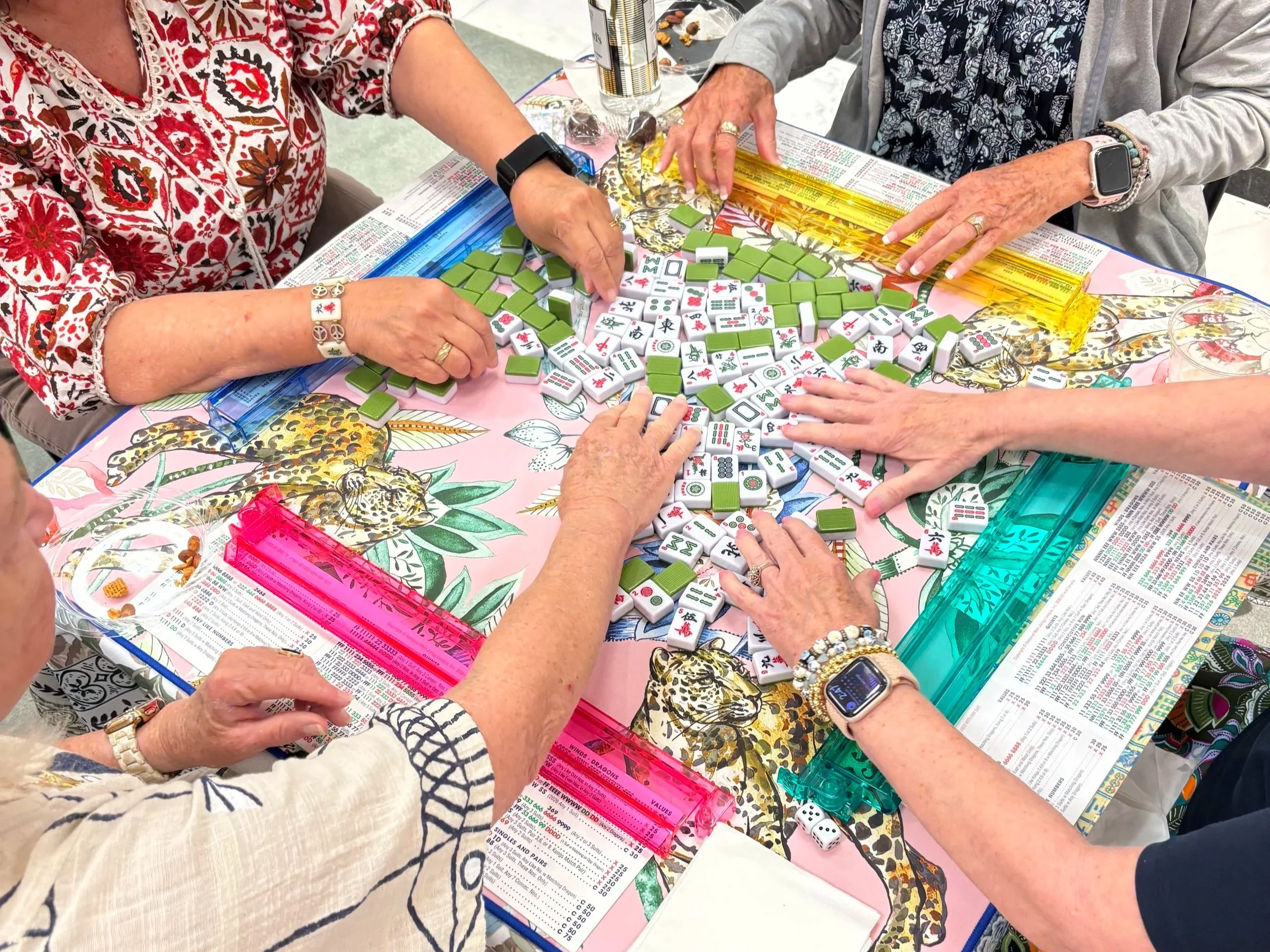
You've seen the table. Four women, tiles clicking, someone laughing so hard she nearly tips her wine. You want in.
Then someone slides the card across to you, and it looks like a spreadsheet had a baby with a bingo sheet. So you decide mahjong must be hard, and you file it on the someday list. The someday list, where perfectly good intentions go to retire.
Here is the honest answer to the question I get asked more than any other. American mahjong is not hard to learn. It is usually taught badly. That is a different thing, and it turns out to be the whole thing.
Let me save you the suspense
Is American mahjong hard to learn? No. Is it often taught in a way that makes sharp, capable women feel slow at their own kitchen table? Constantly.
Almost every beginner who tells me the game is "too complicated" isn't describing the game. She's describing her first encounter with it. The overwhelm is a teaching problem, not a you problem, and I will defend that to anyone who asks.
Why everyone thinks it's hard (and who to blame)
Here's what usually happens. Someone well-meaning sits a beginner down and hands her the entire card, all the rules, the Charleston, the jokers, the exceptions, and the etiquette, in the first hour.
It's like teaching someone to drive by starting with parallel parking. On a hill. In the rain.
The card has dozens of possible combinations on it. A beginner does not need dozens of them on day one. She needs a few, taught clearly, so the game can actually start. Most instructors give too much too soon, and then wonder why their students quietly give up.
If you can count to nine, you're already halfway there
Strip away the noise, and the foundation of American mahjong is small. There are three suits. Dots, Bams, and Craks.
The numbers run one through nine. That's it. If you can count to nine, you can learn and play mahjong, and I mean that as a promise, not a slogan.
Once you can recognize the suits and read a few simple patterns, the tiles stop looking like hieroglyphics and start looking like a puzzle you can actually solve. That shift usually happens faster than anyone expects.
What one good lesson actually looks like
My approach is called Mahjong Made Simple, and the name is the method. I cut everything that isn't essential in the beginning and give you only the building blocks you need to sit down and play.
Not a pretend game. A real one, by the end of your first lesson.
I taught more than a thousand women last year. The ones who tried to conquer the whole card on day one struggled and stalled. The ones I started simple are still at the table, still playing, still texting me when they win.
Here's the part nobody tells you
There is a learning curve. I won't pretend otherwise. But it isn't where you think it is.
Learning enough to play happens quickly. Getting comfortable, reading the table without thinking, trusting your own choices, that part takes a little time. And here's the swerve: that part is the playing, not the studying. The thing that builds your confidence is the very thing you came for.
So is this game actually for you?
Mahjong is for everyone. It's for the woman who wants a standing reason to gather. The one who likes a good puzzle and better company.
If you've been craving a night that's yours, with a table and a few friends and a little friendly competition, this is very likely your game. If that doesn't sound like you, no harm done. But I suspect you wouldn't have read this far.
Come find out
Mahjong won't change your life. It'll just quietly become the thing you rearrange your Tuesday around, and then your friends' Tuesdays too.
The card was never the obstacle. Waiting until you feel ready is. If you're anywhere near Tampa Bay, come to a beginner lesson, and you'll be playing a real game before you leave. Come play. The someday list has had its turn.
The questions I get asked every week
How long does it take to learn American mahjong?
One focused lesson is enough to play a real game. Comfort and speed build over your next few times at the table, whether with my guidance or giving it a try on your own.
Do I need to be good at math?
No. If you can count to nine, you have all the math this game asks of you.
Do I need a group of friends lined up before I start?
No. Come on your own and leave with a table. That happens more often than not.
Is American mahjong the same as the Chinese version?
They share roots but play differently. American mahjong uses the National Mah Jongg League card and jokers, and that's a whole post of its own.
Do I have to memorize the card?
No. You read it, you don't recite it. Nobody memorizes the card on day one, and plenty of seasoned players never do.